
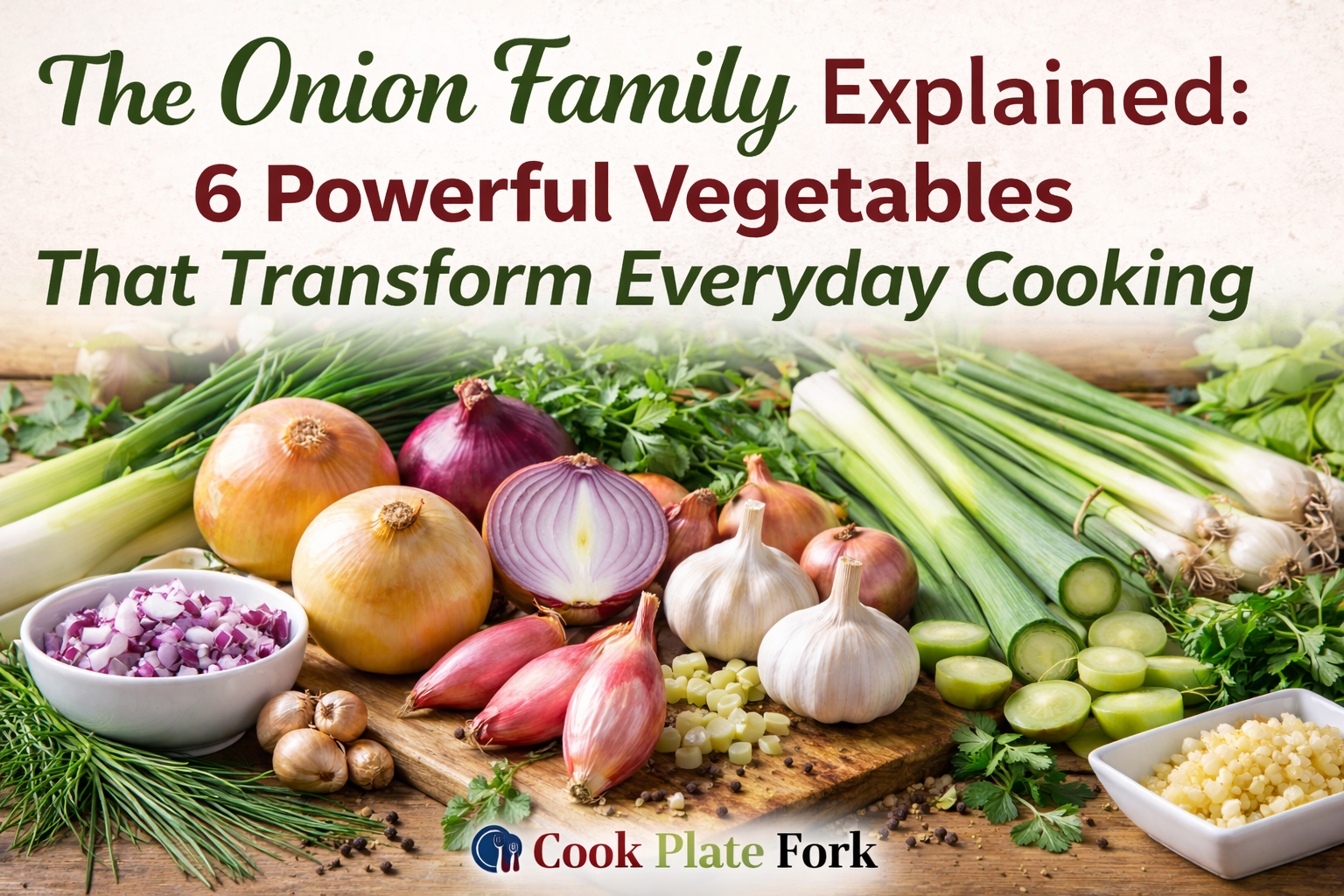

Onions and their Allium relatives are among the most foundational ingredients in cooking. From building flavor bases to finishing dishes with brightness and bite, understanding how each member of the onion family behaves in the kitchen allows you to cook with greater control and confidence.
This guide explores the key varieties, how they differ, and how to use them effectively in everyday cooking.
The onion family is one of the most essential groups of vegetables in kitchens around the world.
Known scientifically as the Allium family, it includes onions, garlic, leeks, shallots, chives, and scallions — ingredients prized for their ability to build depth, add aroma, and bring balance to both simple and complex dishes.
Though closely related, each member offers a distinct flavor profile, intensity level, and ideal cooking application.
Some provide sharp heat when raw, others mellow into sweetness when cooked, and several act as the foundational backbone of soups, stews, sauces, and roasts. Understanding these differences helps you choose the right Allium for the right technique.

Understanding how each vegetable differs in flavor, texture, and use helps cooks make better decisions in the kitchen and get more out of these essential ingredients.
In this guide, we’ll explore each vegetable in the onion family, how it’s used, and what makes it unique in everyday cooking.
Getting to Know the Family of Onions
The onion family includes closely related vegetables that share similar flavor-building qualities while serving different culinary roles.
Some are bold and assertive, while others are mild and delicate, and each is suited to specific techniques and moments in cooking.
Rather than being interchangeable, onions, garlic, shallots, leeks, chives, and scallions work best when chosen intentionally.
Knowing when to use each one allows cooks to layer flavor, control intensity, and create more balanced dishes from start to finish.
Onions: The Foundation of Flavor
Onions are the most widely used vegetable in the Allium family and serve as the backbone of countless recipes.
When cooked slowly over low heat, they can transform into rich, golden caramelized onions with deep sweetness and complexity.
This gentle process draws out natural sugars and creates a soft, jam-like texture that enhances soups, sauces, sandwiches, and grain-based dishes.

Learning how to caramelize onions properly allows this everyday ingredient to become a standout element rather than just a background flavor.
Not all onions behave the same in the kitchen, and choosing the right variety matters.
Yellow onions are the most versatile and are especially well suited for caramelizing and long cooking.
White onions have a sharper, cleaner flavor that works well in sautés and savory bases.
Red onions are best suited for raw preparations, where their crisp texture and mild sharpness shine in salads, thinly sliced on hamburgers, or finely diced as a fresh topping for hot dogs and sandwiches.
White sweet onions develop exceptional sweetness when slowly cooked or roasted.
Understanding these differences helps cooks match the onion to the technique, allowing flavor and texture to develop as intended rather than by chance.

Iron-Skillet Roasted Sirloin With Sweet Peppers & Onions
Onions shine as a featured ingredient in a wide range of finished dishes. From hearty mains like Iron-Skillet Roasted Sirloin With Sweet Peppers & Onions, to fresh, vibrant preparations such as Turkish Tomato And Onion Salad With Olive Oil And Pomegranate Molasses, onions adapt easily to different cuisines and techniques.

Turkish Tomato And Onion Salad With Olive Oil And Pomegranate Molasses
Their natural sweetness becomes especially pronounced in dishes like Butternut Squash With Cranberries, Almonds And Caramelized Onions, where slow cooking brings balance and depth to both savory and sweet elements.

Butternut Squash With Cranberries, Almonds And Caramelized Onions
Understanding how onions behave in different preparations is only part of the equation. Proper handling and storage also play a role in preserving flavor and texture, especially when working with multiple varieties.

Essential Tips For Proper Onion Storage
Learning Essential Tips For Proper Onion Storage helps ensure onions perform as intended from prep to plate.
Takeaway: From building base flavors to topping finished dishes, onions adapt easily to both slow cooking and quick preparations.
Garlic: Bold, Aromatic, and Essent
Garlic brings intensity and warmth to savory cooking. When raw, it is sharp and pungent, but when gently cooked, garlic softens and becomes nutty and sweet.
This transformation makes it one of the most important flavor-building ingredients across cuisines.

Cooking With Garlic: How to Prepare, Use, and Control Flavor
Knowing how to cook with garlic helps prevent bitterness while maximizing aroma and depth.
Whether roasted whole, lightly sautéed, or blended into sauces, garlic adds richness without overwhelming other ingredients.
Garlic becomes especially expressive when paired with proteins and bold seasonings.

Garlic Thyme Chicken Thighs
In dishes like Garlic Thyme Chicken Thighs, slow cooking allows garlic to mellow and infuse the meat with savory depth, while preparations such as Garlic-Soy Pork Noodles highlight garlic’s ability to anchor sauces and balance salty, umami-rich flavors.

Garlic-Soy Pork Noodles
Takeaway: Garlic builds aroma and depth in sauces and marinades and enhances meats, vegetables, and grains when cooked with care.
Shallots: Subtle and Sophisticated
Shallots offer a refined flavor that sits between onions and garlic. Their mild sweetness and tender texture make them especially well suited for quick sautés, pan sauces, and dressings where a softer allium presence is preferred.

Barbecued Charred Green Beans With Bacon And Shallots
This delicate balance allows shallots to enhance vegetables without overpowering them, as seen in dishes like Barbecued Charred Green Beans With Bacon And Shallots, where gentle sweetness rounds out smoky and savory flavors.
Shallots also work beautifully in layered dishes and sandwiches, adding depth without sharpness.

Grilled Cheese Pastrami With Avocado Shallots And Red Roasted Pepper Sandwich
Recipes such as Grilled Cheese Pastrami With Avocado Shallots And Red Roasted Pepper Sandwich highlight how lightly cooked or softened shallots can bring balance to rich, bold ingredients.
When roasted, shallots develop a mellow sweetness that pairs well with spices and high-heat cooking.

Asian-Style Roasted Brussels Sprouts with Red Peppers and Shallots
This quality makes them a natural fit for vegetable-forward dishes like Asian-Style Roasted Brussels Sprouts with Red Peppers and Shallots, where they blend seamlessly into the overall flavor profile.
Takeaway: Shallots add gentle sweetness and refinement to dishes, making them ideal for sauces, dressings, and recipes where a subtle onion flavor is preferred.
Leeks: Mild, Sweet, and Comforting
Leeks bring a gentle onion flavor and soft texture that make them especially well suited for slow cooking and comforting dishes.
With their subtle sweetness and ability to absorb surrounding flavors, leeks are often used as a foundation rather than a dominant ingredient.

The Complete Guide to Leeks: From Market to Table
Understanding how to select, clean, and prepare them properly is key to getting the best results, as outlined in The Complete Guide to Leeks: From Market to Table.
When cooked slowly, leeks become tender and lightly sweet, pairing beautifully with herbs, olives, and other vegetables.

Braised Carrots And Leeks With Olives And Herbs
Dishes like Braised Carrots And Leeks With Olives And Herbs highlight how leeks contribute body and balance without overpowering the plate.
Leeks are also a natural fit for creamy soups and blended dishes, where their mild flavor creates depth without sharpness.

Instant Pot Creamy Leek and Potato Soup with Crispy Shallots
Recipes such as Instant Pot Creamy Leek and Potato Soup with Crispy Shallots showcase how leeks can form the backbone of a dish while supporting richer toppings and textures.
Takeaway: Leeks add gentle sweetness and body to dishes, making them ideal for soups, braises, and slow-cooked recipes where balance matters.
Chives: Fresh and Delicate
Chives are the most delicate member of the onion family and are typically used fresh. Their light onion flavor adds brightness without overpowering a dish.
Finely chopped chives are often used as a finishing touch on eggs, baked potatoes, soups, and dips.
Adding fresh chives just before serving preserves both their color and subtle taste.

Instant Pot Cider-Braised French Lentils With Leeks And Chives
Chives are often added at the end of cooking to brighten and balance richer ingredients.
In dishes like Instant Pot Cider-Braised French Lentils With Leeks And Chives, their fresh, mild onion flavor lifts slow-cooked vegetables and legumes without overpowering the dish.
Takeaway: With their delicate flavor and vibrant color, chives are best used at the end of cooking to add freshness and balance to finished dishes.
Scallions: Crisp and Versatile
Scallions, also known as green onions and sometimes called spring onions, offer a fresh onion flavor, with both the white and green parts used in cooking.

Roasted Sweet Potatoes And Figs
Scallions bring a crisp, fresh onion flavor that works beautifully in both raw and lightly cooked applications.
In dishes like Roasted Sweet Potatoes And Figs, roasted sweet potatoes and figs are piled with green onions and finished with a ginger-chile and balsamic drizzle, letting the scallions’ bright notes balance out rich and roasted flavors.
Takeaway: Scallions add fresh onion flavor and visual brightness, making them ideal for finishing roasted vegetables and balancing rich or sweet ingredients.
Cooking Techniques Across the Onion Family
Understanding how to cook different members of the onion family helps maximize their flavor.
Vegetable & Best Cooking Methods
Onions: Sautéing, caramelizing, roasting
Garlic: Roasting, sautéing, raw
Shallots: Sautéing, raw in dressings
Leeks: Braising, simmering
Chives: Raw, light garnish
Scallions: Grilling, stir-frying, raw
The onion family offers unmatched versatility, flavor, and culinary value.
Knowing how onions, garlic, shallots, leeks, chives, and scallions behave in different dishes allows cooks to build flavor with confidence.
Used thoughtfully, these essential ingredients bring balance, depth, and character to everyday cooking.
Still hungry? These recent recipes are ready when you are.
More Deliciously Yummy Recipes
- Gnocchi Round Up: 10 Ways to Elevate Store-Bought Gnocchi
- How to Cook Store Bought Gnocchi: 5 Easy Methods for Perfect Texture Every Time
- Cooking With Tortellini Pasta: 11 Delicious Ways to Transform This Versatile Ingredient
- Creamy Caramelized Onion Tortellini
- Moist Gluten-Free Almond Flour Strawberry Banana Muffins
Please Share With Your Social Network:

Discover more from Cook Plate Fork
Subscribe to get the latest posts sent to your email.
As always, very informative. Thanks for sharing.
Jeanne
Thank you 😊